Product Views
See how Clawdence keeps delivery under control
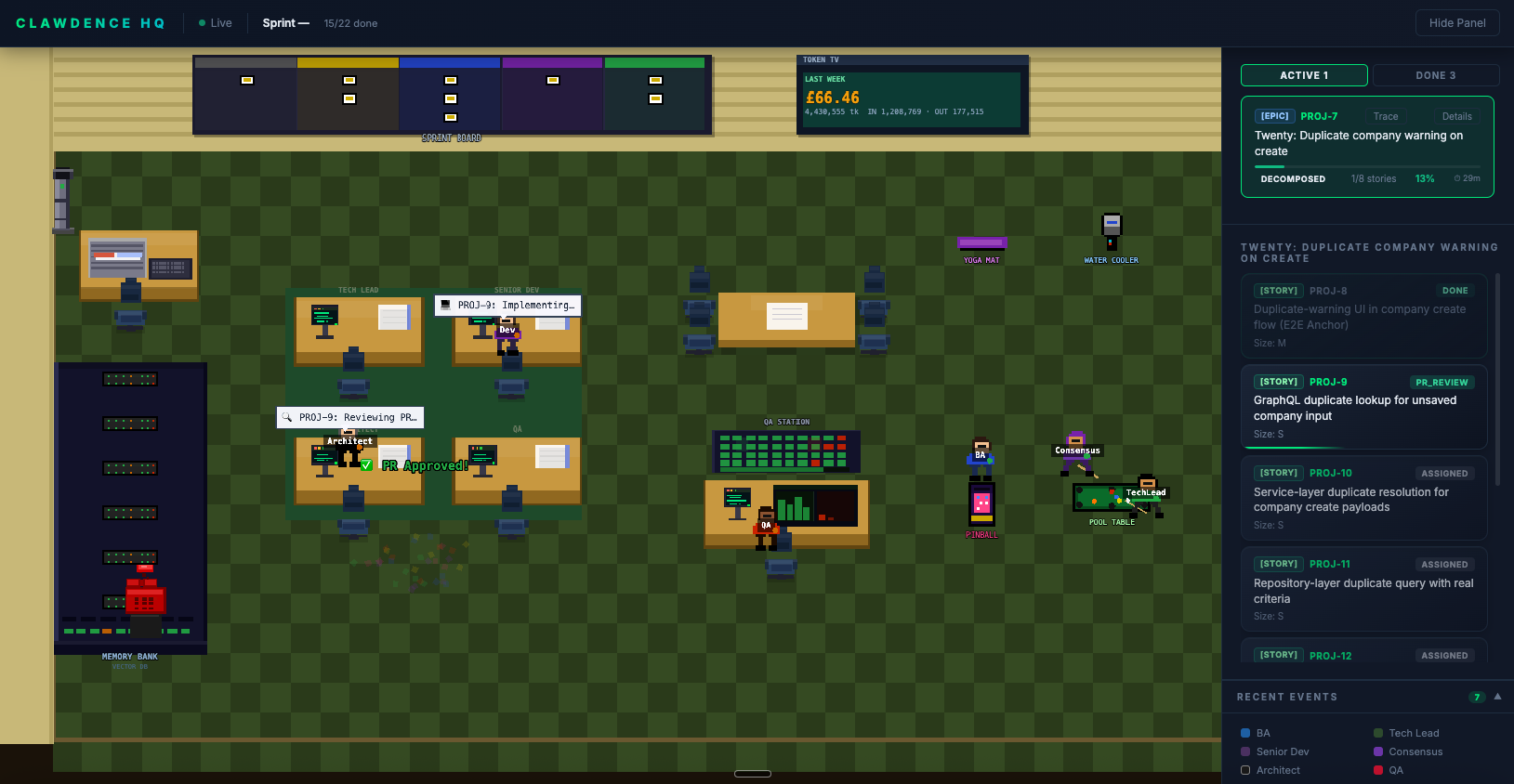
Execution Design shows the planning output for a real epic - how Clawdence reads an existing codebase and sequences stories before a line of code is written. Traceability and Clawdence HQ are live operational views: one shows how work maps back to the original requirement, the other shows the team in motion.
Execution Design
Architecture-aware epic planning that confirms risk early and keeps review units sane.
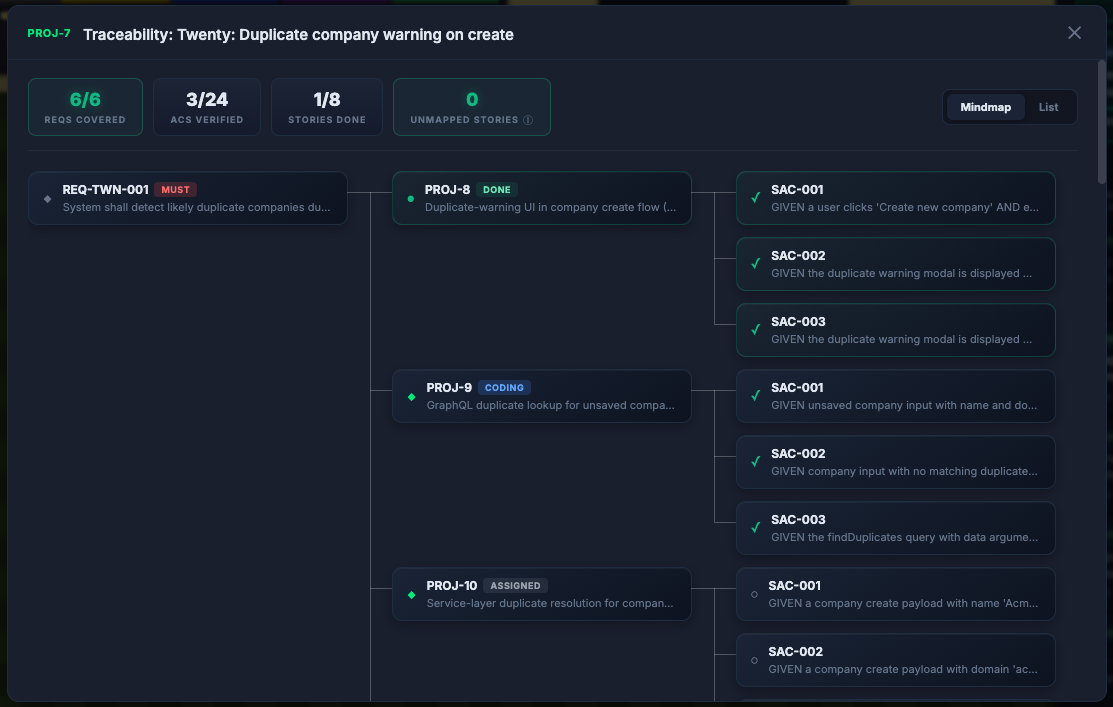
Traceability
Requirement, story coverage, and test evidence in one place.
Clawdence HQ
The team at work - delivery progress, agent activity, and running costs in real time.
Execution Design - Clawdence running against Twenty CRM
It reads the codebase before it plans the work.
This is the planning output for a real Twenty CRM epic - duplicate-company warnings before a new company is created. Clawdence inspected the existing architecture first, surfaced what it found, then sequenced stories to confirm the riskiest integrations before expanding the feature.
Live Example
PROJ-7
Add duplicate-company warnings to Twenty before a new company is created.
Strategic Method
Read the architecture before splitting the work.
Use thin slices to confirm risky integrations early.
Keep stories small enough to review, but large enough to prove a boundary.
Surface hidden contradictions before they become expensive rework.
What It Learned Early
Discovery 01
Twenty already had duplicate-detection infrastructure, so the plan did not invent a new backend path unnecessarily.
Discovery 02
The real missing seam was duplicate lookup against unsaved company input, not duplicate detection itself.
Discovery 03
The create flow had to be confirmed early because the product wording implied a save boundary that Twenty does not actually use.
Discovery 04
The domain uniqueness rule introduced a contradiction with 'continue anyway', so that risk had to be surfaced before implementation expanded.
Ordered Stories
Each story proves a real boundary and only then expands the feature.
No backlog bloat
01
PROJ-8
Confirms integration
Establish the warning step
02
PROJ-9
Finds the real seam
Validate unsaved-input duplicate lookup
03
PROJ-10
Keeps scope thin
Prove service behavior on create payloads
04
PROJ-11
Avoids fake confidence
Verify real criteria against persisted data
05
PROJ-12
User decision path
Open the existing company from the warning
06
PROJ-13
Controlled expansion
Continue creation after review
07
PROJ-14
Defers optional complexity
Add fuzzy similarity only after the baseline works
08
PROJ-15
Prevents downstream rework
Resolve the unique-domain contradiction explicitly
Traceability
Traceability View
Requirement, story breakdown, acceptance coverage, and delivery status in one place. Before review begins, you can confirm exactly what was asked for, how it was broken down, and whether the work stayed in scope.
Operations View
Meet Clawdence HQ
The live control room for the delivery run. The presentation is intentionally playful, but the job is serious - agent activity, active code runner logs, sprint progress, story states, and running costs, all visible while the work is underway.